Businesses today face two pressures at once. They must build better products, and they must ship them faster.
Traditional, step-by-step design (Waterfall UX) makes this hard. It is rigid, slow to change, and raises financial risk. That is why many teams now use Lean UX and Agile methods. Both help teams test ideas early and adapt to users quickly.
In this guide, we explain how Lean UX works. You will learn its core principles, why it beats Waterfall UX, and how it differs from Agile UX.
Lean UX is an outcome-driven design approach. It cuts wasted effort and tests ideas early. Teams build a minimum viable product (MVP) and collect user feedback fast.
Most teams ask, “What should we build?” Lean UX asks a better question: “Why should we build this?” Every answer needs data, not guesswork.
Lean UX borrows the build-measure-learn loop from the Lean Startup method. Teams build small, measure results, and learn before they scale.
This makes design hypothesis-driven. Teams test each decision before they commit to it. By testing early and often, they lower risk and invest in the right solutions.
Collaboration: Designers, developers, and stakeholders work as one team.
MVP focus teams build a basic version first to test core ideas before full development.
Rapid iteration: Teams test and refine designs often, based on real user feedback.
Minimal documentation: Teams skip long reports and focus on prototypes and clear insights.
Continuous learning: Ongoing research and data guide every product decision.
These principles shape every stage of Lollypop’s design process, from discovery to launch.
Here is a quick side-by-side view before we go deeper.
| Factor | Waterfall UX | Lean UX | Agile UX |
|---|---|---|---|
| Process | Linear, one phase at a time | Iterative build-test-learn loops | Iterative sprints |
| Main goal | Complete, detailed plan up front | Validate ideas fast with an MVP | Improve how the team delivers |
| Documentation | Heavy | Light | Moderate |
| Flexibility | Low | High | High |
| Best for | Fixed, well-defined projects | Startups and new products | Teams of any size |
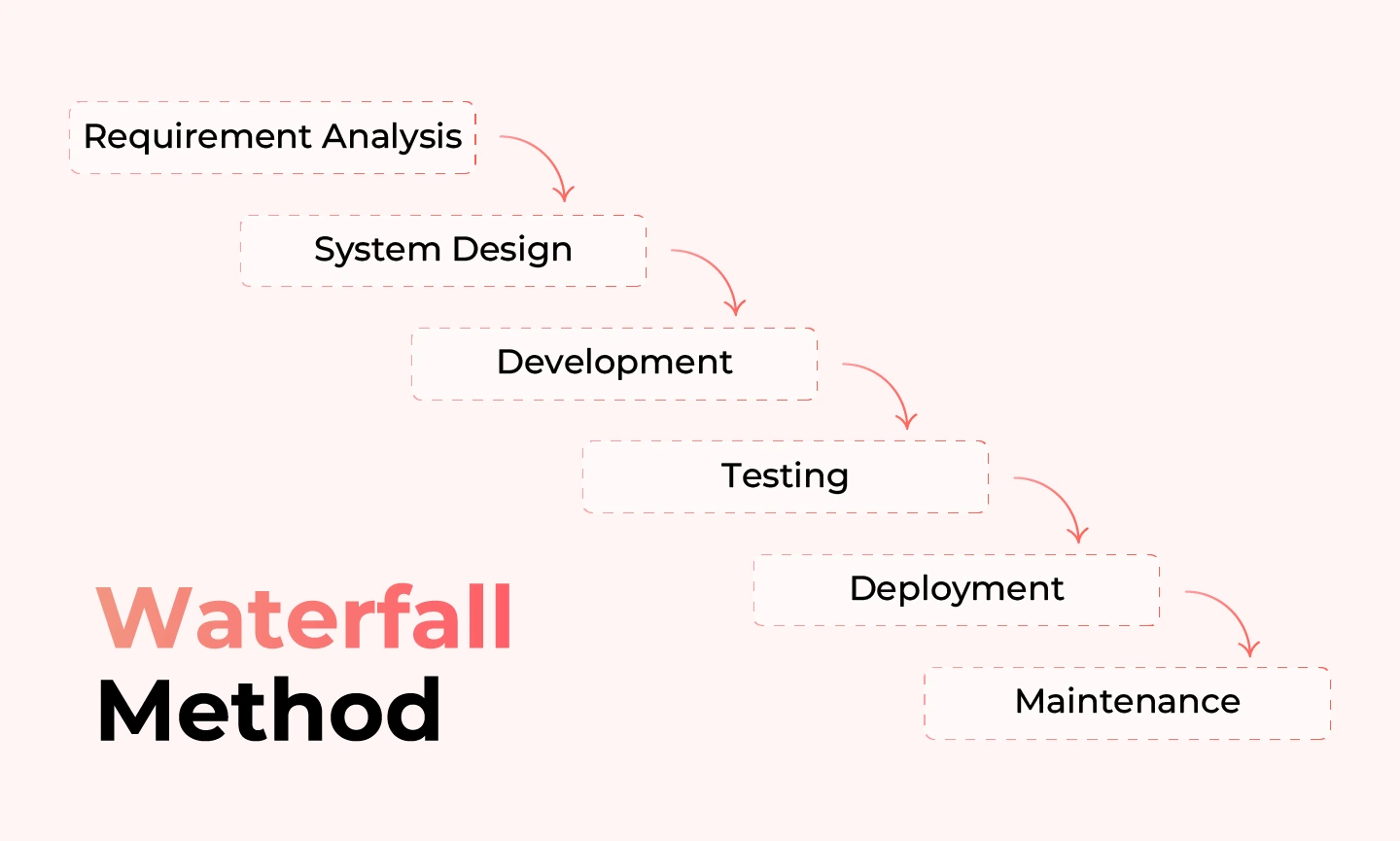
The short answer: Lean UX is faster, more flexible, and less risky. Waterfall UX (also called Traditional UX) follows a fixed sequence that is hard to change. It comes from the waterfall model of software development.
The image above shows how Waterfall UX works. Teams finish research, then design, then development, then testing. Each phase must end before the next one starts. This makes it hard to respond to user feedback.
Lean UX removes these strict handoffs. Teams improve designs continuously instead of waiting for each phase to finish.
Designers form a hypothesis, build a prototype, and get user feedback right away. This fast loop keeps the design focused on what users actually need.
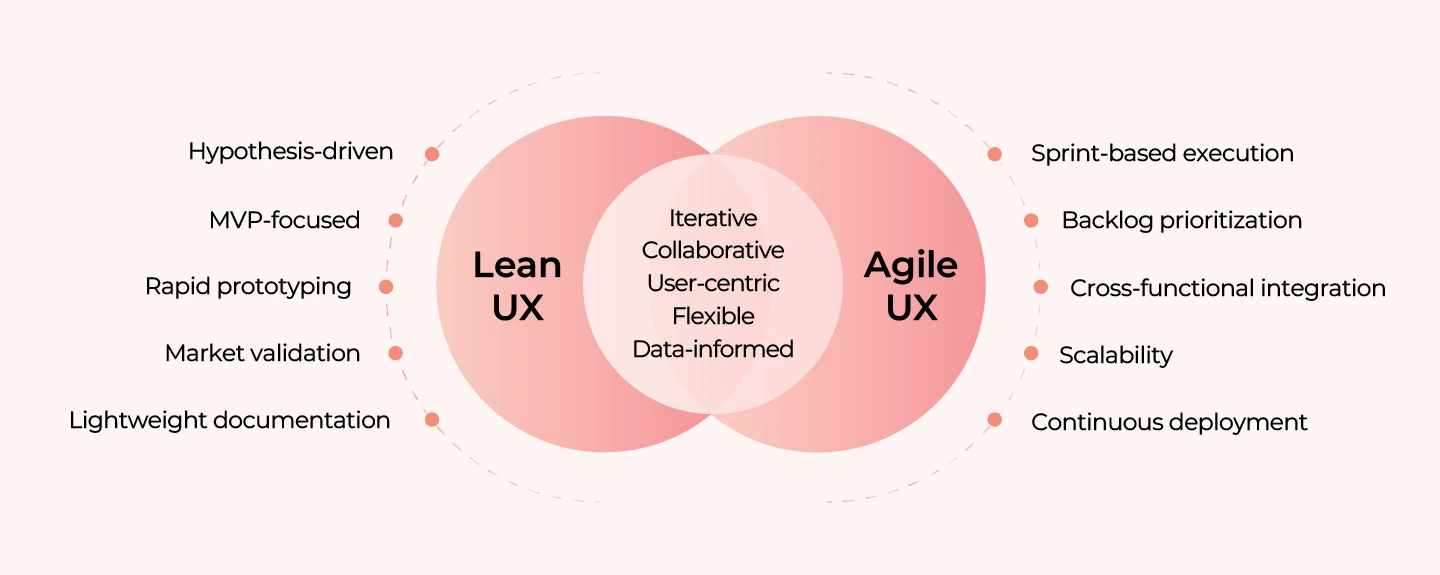
Lean UX is the go-to approach for startups. Its main strength is speed. Teams launch an MVP early and improve it based on real feedback. This lets them test ideas before spending big budgets. It also keeps development aligned with real user needs.
Agile UX also uses iteration, but it does not center on MVPs. Companies of any size can use it. Lean UX aims for quick market validation. Agile UX aims to improve the process itself. It builds cross-team collaboration and steady improvement across the whole project.
Planning an MVP?See how our team runs Lean UX projects in 2–3 months.

The Lean UX process runs in three repeating stages: Think, Make, and Check.
In the Think stage, the team studies the problem. They define user needs and form hypotheses. The goal is to solve a real problem, backed by insight rather than assumption.
The team runs user research, such as interviews, surveys, and behavior analysis. They study competitors to find best practices. They also talk to stakeholders to connect business goals with user needs. By the end, everyone shares the same view of the problem and the next steps.
In the Make stage, ideas take shape.
The team uses Think-stage insights to brainstorm and sketch solutions. They build low-fidelity prototypes or minimum viable products (MVPs) to test their hypotheses. Speed matters more than polish here. The goal is to create something users can react to quickly.
In the Check stage, the team tests whether the solution works for users. Real users try the prototype or MVP. The team gathers qualitative and quantitative feedback, then analyzes the results.
The aim is to learn what works, what does not, and why. If a hypothesis proves wrong, the team adjusts and starts the loop again.
Product design never really ends. Teams keep improving the user experience over time.
A Lean framework helps businesses build MVPs fast, test key ideas, and check usability with real users. This lowers risk and speeds up learning. Teams can experiment without large financial losses and launch a product the market is ready for.
Need a partner to design and validate your MVP? Lollypop Design Studio specializes in Lean UX design. We deliver results in just 2–3 months, which suits startups and SMEs.
We start with a discovery workshop. Our design experts align on your goals, prototype your MVP, and run real-time user testing. Then we refine the product based on what users tell us.
Lean UX is iterative and collaborative. It relies on quick experiments, cross-team work, and constant feedback. It favors real-world testing over heavy documentation.
Traditional UX (Waterfall UX) is linear. Research, wireframes, prototypes, and usability tests all happen before development starts. This gives thorough planning, but it takes longer and adapts poorly to change.
Lean UX research uses light, flexible methods. Guerrilla testing runs quick usability tests in natural settings. Short surveys and micro-interviews check specific assumptions.
Rapid prototyping lets teams test low-fidelity designs and refine them. A/B testing and behavioral analytics show how real users behave, so decisions stay data-driven.
A minimum viable product (MVP) is the simplest version of a product. It includes only the features needed to test core functions and gather feedback. MVPs help businesses test assumptions, cut costs, and improve quickly. The goal is to learn what works before investing in full development. Read our complete MVP guide to learn more.
An MVP delivers core features with minimal effort. User experience and polish often suffer as a result. This can lead to clunky screens, broken workflows, and usability gaps.
Good UX keeps early products easy to use while still limiting features. An MVP can prove market demand. But if usability is ignored, users may not adopt the product.
Yes. Lollypop’s Lean UX approach follows a “Build fast, launch fast” philosophy. It helps startups bring an MVP to market quickly, usually within 2–3 months. Visit our process page to see how we apply Lean UX in action.